NWO Demonstrator Grants: cell implant for retinal disorders and revolutionary microbiology
Publication date: 29-09-2026
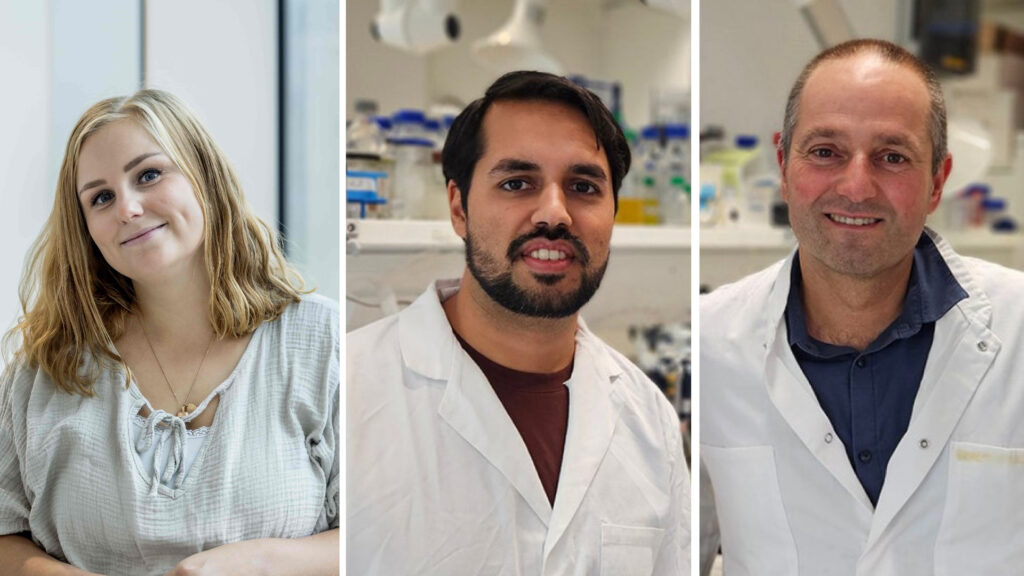
Céline Koster of Amsterdam UMC), Jeroen Koendjibiharie and Herwig Bachmann (Vrije Universiteit Amsterdam)
From an implant that may help restore lost vision to a technology that drastically speeds up microbiological laboratory work: researchers from Amsterdam have also been awarded an NWO Demonstrator grant. Curious to find out who?
SupraVision: cell implant for retinal disorders by Céline Koster-de Goede, Amsterdam UMC
The SupraVision project focuses on the development of a cell implant for patients with retinitis pigmentosa (RP). This is a group of inherited retinal disorders in which the light-sensitive cells in the eye are gradually lost, which can lead to severe visual impairment or blindness.
The researchers are investigating whether transplanting these cells can slow down further deterioration and support the remaining function of the retina.
The NWO Demonstrator grant will be used to investigate the safety and efficacy of the technology in a patient-based animal model. The results should provide insight into how the implant works and the next steps required to achieve clinical impact for patients.
“I am extremely grateful for this support. It will enable us as a team to take an important step towards bringing our technology closer to patients.” Céline Koster-de Goede
Evovector: Industrial fermentation processes with economic potential by Herwig Bachmann and Jeroen Koendjbiharie, VU Amsterdam
Laboratory evolution is a key method for developing microorganisms that perform better in industrial fermentation processes. For example, it enables researchers to use microorganisms to produce desired substances more efficiently. Demand for such biotechnological applications is growing rapidly.
A major bottleneck is that laboratory evolution requires a great deal of time and manual labour. As a result, experiments can be expensive and scaling up this method is difficult. Bachmann and Koendjbiharie are therefore developing Evovector. The technology makes it possible to carry out experiments more easily and on a larger scale. According to the researchers, this could reduce the labour costs of laboratory evolution experiments by up to 90 per cent.