€6 million for Innoseis: high-tech sensors for self-driving cars, satellites and soil research (soon to be used on the Moon too)
Publication date: 9-11-2026
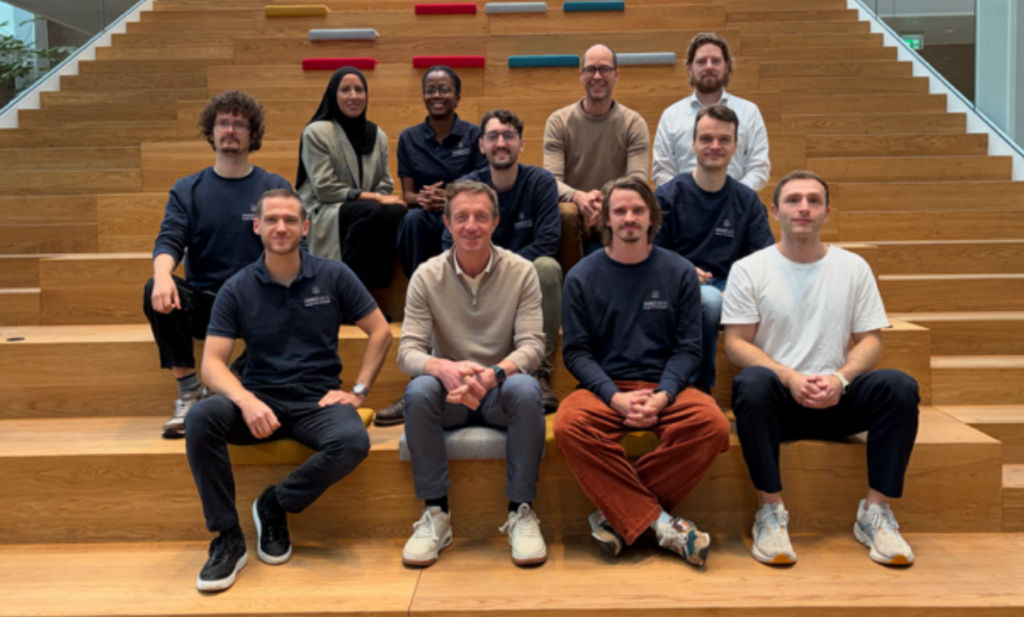
Photo: Innoseis Sensor Technologies Team. Second from the left at the bottom: CEO Mark Beker
Thanks to a massive investment, deep-tech company Innoseis is set to produce many more sensors. These will even be used for soil research on the moon in the near future. The technology has been developed over the past ten years, drawing on research in physics.
CEO Mark Beker explains what it takes to develop a high-tech product.
All the things you can do with underground vibrations
Just imagine: you insert special ‘pins’ into the ground, send vibrations into the ground and capture the reflections. This allows you to map the entire subsurface. Futuristic? Not at all! Discoveries in physics formed the basis for a new generation of sensors that soon became highly sought-after by the oil and gas industry.
Mark Beker (Nikhef) and Jo van den Brand (VU) saw many more potential applications. “We’re essentially creating a highly sensitive motion detector that can be used in satellites, spacecraft and (autonomous) vehicles to determine their position more accurately,” explains Mark Beker, CEO of Innoseis.
From Dutch soil to the Moon
Innoseis sold its first technology and invested the proceeds in a new development programme. The result? Prototypes based on an entirely new technology and an enthusiastic, innovation-minded team. The prototypes are now in operation in satellites and will soon be used for soil research on the Moon.
“The extremely high sensitivity of a sensor the size of a microchip makes it possible to carry out measurements that were previously impossible,” emphasises Mark Beker, CEO of Innoseis.
Laying the foundations for the future: investment to scale up
The recent investment of €6 million, provided by investment firm FORWARD.one, is being used to ramp up production. The sensors can be used in areas such as CO₂ storage, navigation, robotics, infrastructure and defence. But first, these sensors must be feasible to manufacture. Ties van Rappard, Business Developer at IXA, reflects:
“At IXA, we are continuously involved with Innoseis. Following the initial sale, IXA-VU and Nikhef reinvested their proceeds into the current Innoseis. When FORWARD.one made its investment, we were asked whether we could amend a few terms from the past. Through constructive dialogue, we reached a satisfactory resolution, enabling us to support this investment, which is crucial for Innoseis’s growth. A fantastic milestone for us all.”
Mark Beker is already looking ahead: “Our ambition is to become the global market leader in this sector. With our sensors, we are helping to address societal challenges such as safe CO₂ storage and infrastructure monitoring. And the next challenge lies literally beyond Earth: our sensors will soon be heading to the Moon.”
About Innoseis
Innoseis has its origins at the Netherlands Institute for Subatomic Physics (Nikhef), where Mark Beker (CEO) and Jo van den Brand (CTO) conducted research into the detection of gravitational waves.
IXA has been involved from the very beginning.
