Amsterdam well represented in the Drug Repurposing Venture Challenge 2026, with Vergilius Therapeutics as the winner
Publication date: 10-11-2026
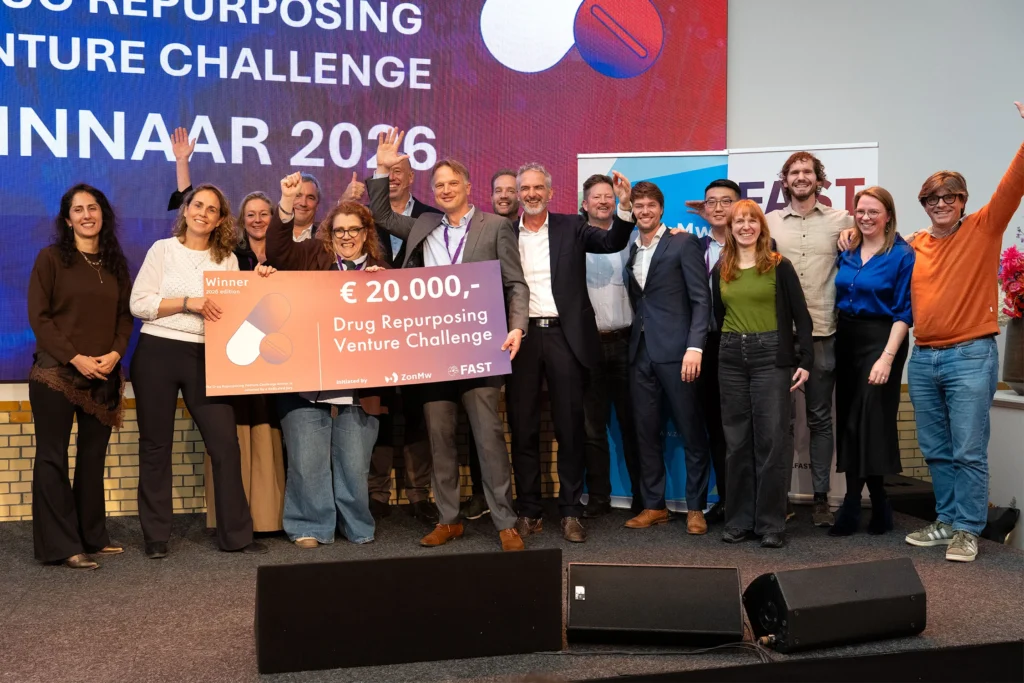
The challenge? To turn a new application for an existing medicine into a business plan. Winner Vergilius Therapeutics (Amsterdam UMC) is working on a treatment for recurrent melanoma and received a cheque for €20,000. Flux Therapeutics (VU Amsterdam) also took to the stage with a potential solution for Alzheimer’s disease.
Both Amsterdam-based participants in the Drug Repurposing Venture Challenge 2026 (DRVC) had previously received three months’ coaching in the areas of drug development, entrepreneurship and financing. This was provided by experts from ZonMW and FAST.
Important? Absolutely: developing existing medicines for new applications offers opportunities to develop treatments more quickly and at lower cost. Here are the two Amsterdam projects and their plans!
Vergilius Therapeutics’ development plan with a focus on affordability
Vergilius Therapeutics (Amsterdam UMC) focuses on preventing recurrent melanoma, an aggressive form of skin cancer. The team impressed the jury with a strong presentation and convincing answers to their questions.
Tanja de Gruijl, of the Cancer Centre at Amsterdam UMC, made the discovery that lies at the heart of the new treatment. She discovered that CpG, a component of vaccines, prevents melanoma recurrences in patients. “It is one injection, given locally, at the spot where the tumour originally was located,” Tanja explains.
Strictly speaking, Vergilius Therapeutics is not yet a company. That could well be how the prize money is spent. “We are very happy that we won. It feels like a stamp of approval from experts: there really is something promising here, and we should go for it”, adds Tanja de Gruijl.
Flux Therapeutics: Using an HIV drug in a new way to treat Alzheimer’s disease
Researcher Rik van der Kant observed that Alzheimer’s patients accumulate too much cholesterol in the brain. It is known that a low dose of the original HIV drug Efavirenz helps brain cells to get rid of cholesterol.
“In the Venture Challenge, we learnt how to get that discovery to patients. Who will invest? What will it cost? And how can the drug remain affordable?”, explains Rik van der Kant, a researcher at VU Amsterdam.
Ties van Rappard, Business Developer at IXA-VU, adds: “We’re using the answers to those questions to set up Flux Therapeutics in 2027. To attract investment, patent protection is needed. During the Venture Challenge, we also learnt that there are indeed opportunities for patent protection in drug repurposing.”