A brand-new solution to reduce injuries in women’s football
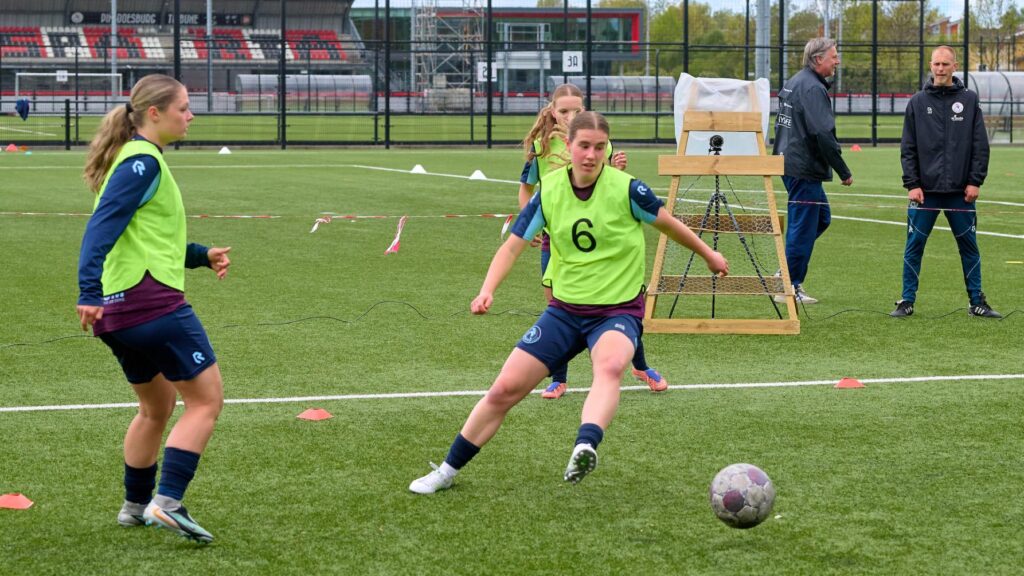
Cruciate ligament injuries are becoming an increasingly significant problem in women’s football. A new method enables a better understanding of (high-risk) movement patterns among players directly on the pitch. And that’s a first! To this end, Amsterdam University of Applied Sciences (HvA) and Sparta Rotterdam are joining forces with PlaySafe: FieldLab.
Football dreams and movement patterns
“Women’s football is hugely popular,” begins Nils Jongerius, a sports scientist with a PhD who works at HvA. “But as the number of women playing football has risen in recent years, so too has the number of knee injuries, specifically cruciate ligament tears.”
Research at the HvA, known as PlaySafe, provides unique insights into high-risk movements such as landings and turns: “Through this research, we demonstrated that we can measure the movement patterns of female footballers using new technology. With cameras positioned around the pitch, simply during a training session and without the need for sensors. It is useful for football clubs to know when there is a change in a player’s movement behaviour, as this can indicate an increased risk of injury. This is therefore important information that can support the coaching staff and medical team in their decisions during rehabilitation, as well as in deciding whether to select a player for a football match,” said Nils Jongerius.
We demonstrated that we can measure the movement patterns of female footballers using new technology
Injury prevention right on the pitch
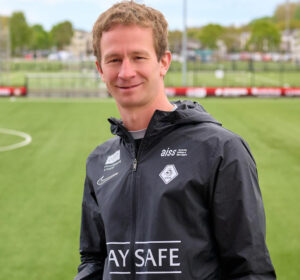
Nils Jongerius is therefore working hard on a new application in collaboration with Sparta Rotterdam. The researchers provide the data, which Sparta’s coaches and medical staff then use at key decision-making moments, for example during training sessions. The aim is for the project to develop into a scalable, practical and affordable service for professional football organisations.
Jongerius: “We’re doing this in collaboration with the IXA and the Sport Management & Sport Business research group at the HvA. We’re supported throughout the process by Physiotherapy and Sports Science students. […] And that’s exactly what we want: to help the practice sector move forward with insights from scientific research.”
Kathrin Metselaar, Business/Impact Developer at IXA, adds to this: “The HBO Takeoff scheme provides room to develop research ideas into practical applications. Together with Nils, I successfully submitted an application for this and secured the grant. A first for the HvA!”
About PlaySafe: FieldLab
PlaySafe: FieldLab is a nine-month follow-up to the earlier PlaySafe study, carried out as a collaboration between the HvA and Sparta Rotterdam. Both partners jointly received a grant of €40,000 from the SIA Coordination Body for this study.
This article is an abridged version of a full interview (in Dutch) with Nils Jongerius (HvA) and Jonneke Schuurbiers of Sparta Rotterdam.